Hastings Banda
First president of Malawi, ruling from 1964 to 1994.

via Wikipedia: Hastings Banda · see source
Hastings Kamuzu Banda (c. 1898 or 1906 – 25 November 1997) was a Malawian politician who served as the leader of Malawi from 1964 to 1994. He served as Prime Minister from independence in 1964 to 1966, when Malawi was a Dominion/Commonwealth realm. In 1966, the country became a republic and he became the first president as a result, ruling until his defeat in 1994. After receiving much of his education in ethnography, linguistics, history, and medicine overseas, Banda returned to Nyasaland to speak against colonialism and advocate for independence from the United Kingdom. He was formally appointed Prime Minister of Nyasaland and led the country to independence in 1964. Two years later, he proclaimed Malawi a republic with himself as the first president. He consolidated power and later declared Malawi a one-party state under the Malawi Congress Party (MCP). In 1970, the MCP made Banda the party's president for life. In 1971, he became president for life of Malawi itself. A renowned anti-communist leader in Africa, he received support from the Western Bloc during the Cold War. He generally supported women's rights, improved the country's infrastructure, and maintained a good educational system relative to other African countries. However, Banda presided over one of the most repressive regimes in Africa, an era that saw political opponents regularly tortured and murdered. Human rights groups estimate that at least 6,000 people were killed, tortured, and jailed without trial. As many as 18,000 people were killed during his rule, according to one estimate. His rule has been characterised as a 'highly repressive autocracy'. Banda also received criticism for maintaining full diplomatic relations with the apartheid government in South Africa. By 1993, amid increasing domestic and international pressure, he agreed to hold a referendum which ended the one-party system. Soon afterwards, a special assembly ended his life-term presidency and stripped him of most of his powers. Banda ran for president in the democratic elections that followed and was defeated. He died in South Africa in 1997.
- born
- c. 1898 or 1906 (date uncertain)
- died
- 25 November 1997
- field
- Politics, Medicine
- nationality
- Malawian
- known_for
- First president of Malawi; leader from 1964 to 1994; declared president for life
Verified Timeline
Lore & Background
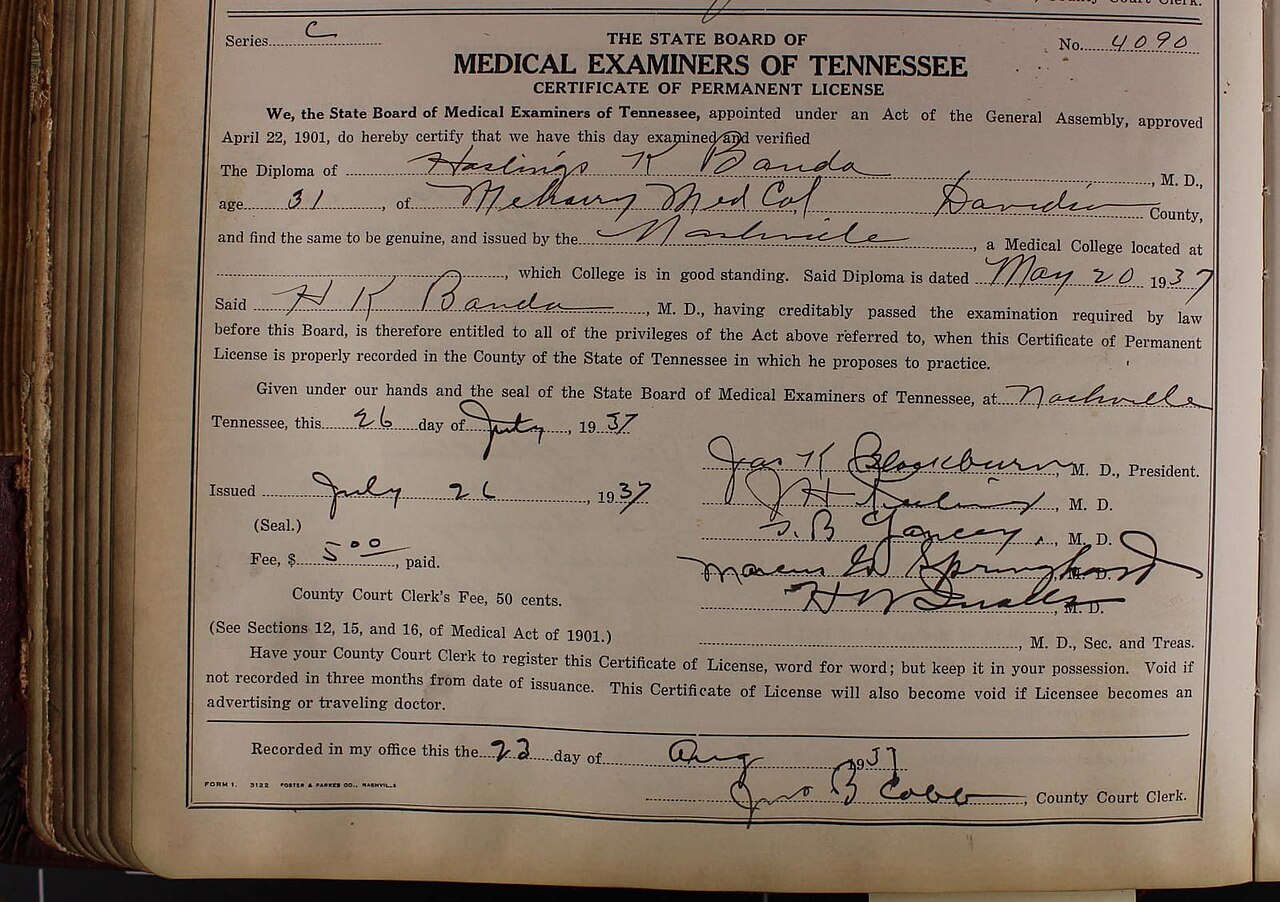
Hastings Kamuzu Banda was born Akim Kamnkhwala Mtunthama Banda near Kasungu in Malawi (then British Central Africa) to Mphonongo Banda and Akupingamnyama Phiri. His date of birth is unknown, but Banda himself often gave his date of birth as 14 May 1906. Later, when presented with evidence of certain tribal customs by a friend, Dr Donal Brody, Banda said: 'No one knows the hour, the date, the month or the year in which I was born, although I now accept the evidence that you give me – March or April 1898.' He left his village school near Mtunthama for his maternal grandparents' home and attended Chayamba Primary School in Chikondwa. In 1908, he moved to Chilanga mission station and was baptised in 1910. The name Kamnkhwala, meaning 'little medicine', was replaced with Kamuzu, which means 'little root'. The name Kamuzu was given to him because he was conceived after his mother had been given root herbs by a medicine man to cure infertility. He took the Christian name of Hastings after being baptised into the Church of Scotland by Dr George Prentice, a Scot, in 1910, naming himself after John Hastings, a Scottish missionary working near his village whom he admired. Around 1915–16, he left home on foot with Hanock Msokera Phiri, an uncle who had been a teacher at the nearby Livingstonia mission school, for Hartley, Southern Rhodesia (now Chegutu, Zimbabwe). He desired to enroll at the Scottish Presbyterian Lovedale Missionary Institute in South Africa but completed his Standard 8 education elsewhere. In 1917, he left on foot for Johannesburg in South Africa. He worked at the Witwatersrand Deep Mine on the Transvaal Reef for several years. During this time, he met Bishop William Tecumseh Vernon of the African Methodist Episcopal Church (AME) who offered to pay his tuition fee at a Methodist school in the United States if he could pay his own passage. In 1925, he left for New York. Banda studied in the high school section of the Wilberforce Institute, an African American AME college (a member of AME), now known as Central State University, in Wilberforce, Ohio, and graduated in 1928 with a diploma. With his financial support now ended, Banda earned some money from speaking engagements arranged by the Ghanaian educationalist Kwegyir Aggrey, whom he had met in South Africa. Speaking at a Kiwanis club meeting, he met Dr Herald, with whose help he enrolled as a pre-medical student at Indiana University. At Bloomington, he wrote several essays about his native Chewa tribe for the folklorist Stith Thompson, who introduced him to Edward Sapir, an anthropologist at the University of Chicago, where he transferred to after four semesters. During his period there, he collaborated with the Afro-American anthropologist and linguist Mark Hanna Watkins, providing information on his native Chewa language. This led to the publication of a grammar book of the language. In Chicago, he lodged with an African-American, Corinna Saunders. He majored in history, graduating with a B.Phil. degree in 1931. During this time he enjoyed financial support from Mrs. Smith, whose husband, Douglas Smith, had made a fortune from patent medicines and Pepsodent toothpaste and who was a member of the Eastman Kodak board. He then, still with financial support from these and other benefactors (including Walter B. Stephenson of the Delta Electric Company), studied medicine at Meharry Medical College in Tennessee, from which he obtained an M.D. degree in 1937. Banda became the second Malawian person to receive a medical degree, following Daniel Sharpe Malekebu. While studying at Meharry Medical College in Tennessee, Banda married Robertine Edmonds in 1934. To practise medicine in territories of the British Empire, however, Banda was required to gain a second medical degree. He attended the University of Edinburgh and was subsequently awarded a Scottish triple conjoint diploma (with post-nominals LRCP(Edin), LRCS(Edin) and LRCPSG) in 1941. His studies were funded by stipends of £300 per year from the government of Nyasaland (to facilitate his return there as a doctor) and from the Church of Scotland; neither of these benefactors was aware of the other. (There are conflicting accounts of this. He might still have been funded by Mrs. Smith.) When he enrolled for courses in tropical diseases in Liverpool, the Nyasaland government terminated his stipend. He was forced to leave Liverpool when he refused on conscientious grounds to be conscripted as an Army doctor. He also became an elder of a parish in the Church of Scotland. Between 1941 and 1945, he worked as a doctor in North Shields, near Newcastle upon Tyne. He was a tenant of Mrs. Amy Walton at this time in Alma Place in North Shields and sent a Christmas card to her every year right up until her death in the late-1960s. In 1944, he met Merene French, the daughter-in-law of one of his patients, and began a relationship with her. After World War II, he established a practice at the London suburb of Kilburn and became politically active by joining the Labour Party and Fabian Colonial Bureau, which was founded in 1940. Banda moved to London in 1945, buying a practice in the North London suburb of Harlesden. In 1945, at the behest of Chief Mwase of Kasungu, whom he had met in England in 1939, and other politically active Malawians, he represented the Nyasaland African Congress at the Fifth Pan-African Congress in Manchester. This conference was attended by other future African leaders, Jomo Kenyatta and Kwame Nkrumah. With help from sympathetic Britons, he also lobbied in London on behalf of the Congress. Banda was actively opposed to the efforts of Sir Roy Welensky, a politician in Northern Rhodesia, to form a federation between Southern and Northern Rhodesia with Nyasaland, a move which he feared would result in further deprivation of rights for the Nyasaland blacks. The federation, which he considered 'stupid', was formed in 1953. It was rumoured with some excitement that he would return to Nyasaland in 1951, but he moved instead to the Gold Coast in West Africa. He went there partly because of a scandal involving his receptionist in Harlesden, Merene French (Mrs. French); despite reports that she became pregnant with his child, this has never been confirmed. Banda was cited as a co-respondent in the divorce of Mr. French and accused of adultery with Mrs. French. She followed Banda to West Africa, but he wanted nothing more to do with her. She died in 1976. Several influential Congress leaders, including Henry Chipembere, Kanyama Chiume, Dunduzu Chisiza and T.D.T. Banda (no relation) pleaded with him to return to Nyasaland to take up leadership of their cause. A delegation sent to the UK met with Banda at the Port of Liverpool, Liverpool, where he was making arrangements to return to Ghana. He agreed to return, but asked for some time to sort out a few private matters. The delegation returned without him and proceeded to make arrangements for his imminent return. After two false starts, including a fracas between the police and African crowds threatening to storm a BOAC airplane rumoured to be carrying Dr. Banda at Chileka Airport, Banda finally made a showing on 6 July 1958 after an absence of about 42 years. In August, at Nkhata Bay, he was acclaimed as the leader of the Congress.
Reader's Guide
Banda's significance lies in his role as the founding leader of independent Malawi and his long, autocratic rule. He led the country to independence from the United Kingdom in 1964, initially as Prime Minister, then as president after declaring Malawi a republic in 1966. He consolidated power, making Malawi a one-party state under the Malawi Congress Party, and was named president for life in 1971. His regime was noted for improving infrastructure and education, and for supporting women's rights, but also for extreme repression, with estimates of 6,000 to 18,000 people killed, tortured, or jailed without trial. He maintained diplomatic relations with apartheid South Africa, drawing criticism. Under domestic and international pressure, he agreed to a referendum in 1993 that ended the one-party system, and was later stripped of his life presidency. He ran in the subsequent democratic elections and was defeated. Banda died in South Africa in 1997.
Did You Know?
- Banda's birth name was Akim Kamnkhwala Mtunthama Banda; 'Kamnkhwala' means 'little medicine', later replaced with 'Kamuzu' meaning 'little root' because he was conceived after his mother was given root herbs to cure infertility.
- He walked from his home in Nyasaland to Hartley, Southern Rhodesia around 1915–16, and later to Johannesburg in 1917, where he worked at the Witwatersrand Deep Mine.
- Banda earned an M.D. from Meharry Medical College in 1937, becoming the second Malawian person to receive a medical degree, after Daniel Sharpe Malekebu.
- While studying at the University of Chicago, he collaborated with anthropologist Mark Hanna Watkins to produce a grammar book of the Chewa language.
- Banda was cited as a co-respondent in the divorce of Mr. French, accused of adultery with his receptionist Merene French; she followed him to West Africa, but he wanted nothing more to do with her.
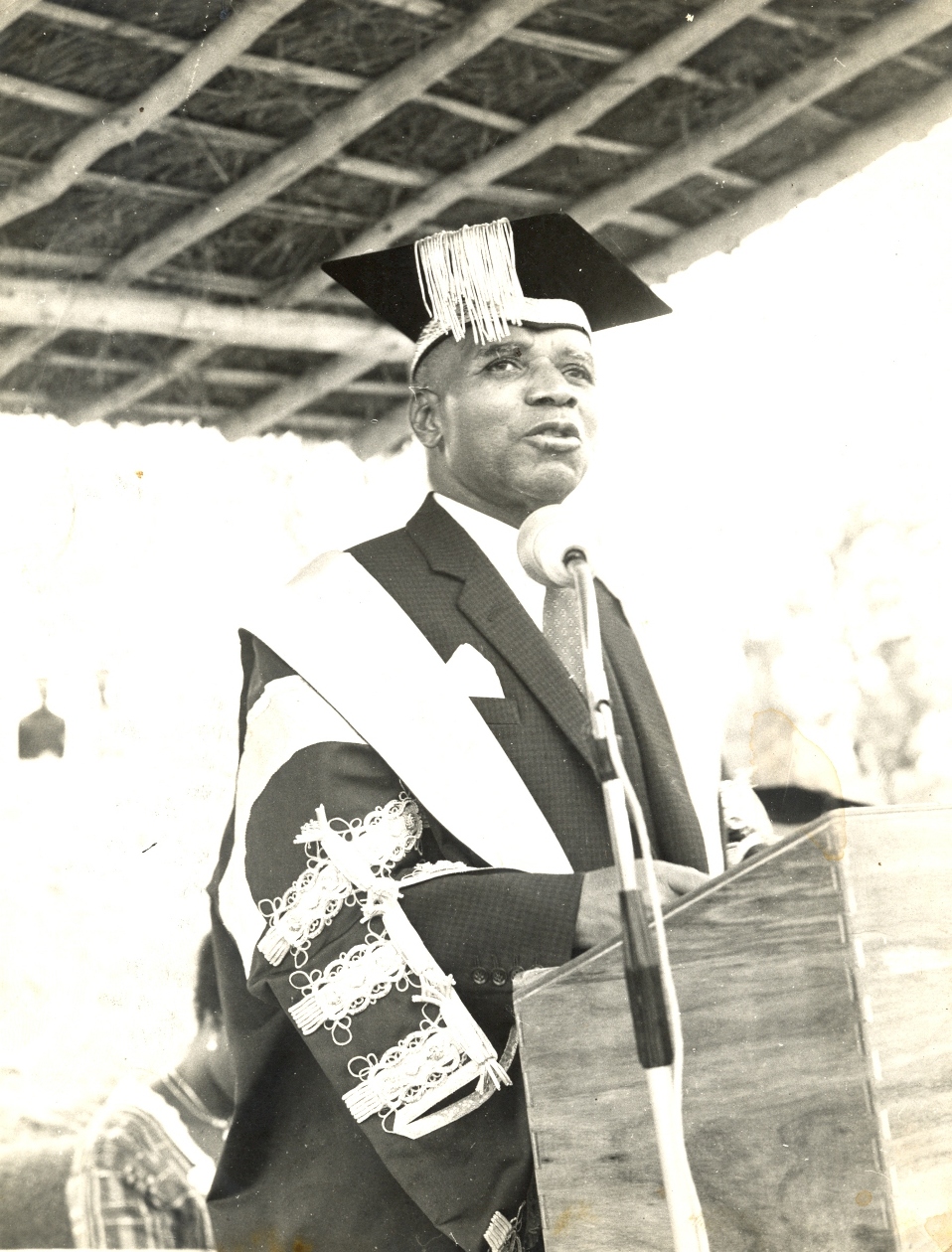
Gallery
Frequently Asked Questions
Who is Hastings Banda?
Hastings Kamuzu Banda was a Malawian politician and physician who led his country from independence in 1964 until his ouster in 1994. He is best known as Malawi's first president and one of Africa's longest-serving heads of state.
What was Hastings Banda's political role and how did it evolve?
He first became Prime Minister of the newly independent Malawi in 1964, then assumed the presidency in 1966. In 1971 he declared himself president for life, consolidating his grip on power for the remainder of his tenure.
How did Hastings Banda's rule come to an end?
After three decades of one-party dominance, Banda was defeated in the 1994 multiparty elections, which marked the end of his authoritarian regime. He died in South Africa on 25 November 1997, several years after leaving office.
Why is Hastings Banda considered important in African political history?
His thirty-year rule shaped Malawi's institutions, economy, and social fabric, and his blend of infrastructure development with political repression made him a defining figure in post-colonial African governance. His eventual defeat also became a landmark moment in the continent's broader democratic transitions of the 1990s.
What are the key dates in Hastings Banda's life?
His birth year is uncertain, generally cited as either 1898 or 1906, and he passed away on 25 November 1997. His political career spanned from Malawi's independence in 1964 to his electoral defeat in 1994.
More in African Leaders 1-18
Spotted an error? Know more?
This is a living reference — every entry is fact-audited, and reader corrections feed straight into our audit queue. Suggest an edit · See this site's audit record